
What’s This About You… Writing Stories?

Updated: 2 hours ago

By Paul Ponce
Buenos Aires, December 2001. Argentina’s social, financial, and political crisis came crashing down like a giant asteroid.
Where was I? Working as a producer for Endemol. We’d just wrapped the second season of what was then a revolutionary reality TV show. Big Brother.
Gran Hermano for the locals.
Twelve people chasing fame and fortune had voluntarily entered a house with dozens of cameras watching them, completely cut off from life outside.
They kinda missed a few beats.
Out in the world, the aftermath of 9/11 was still fresh. And at home, the heat kept rising on the economy and government.
By December, the whole country was a pressure cooker.
On December 19th, the damn lid blew off.

For those of us in the studio, reality had become pretty strange, too.
Most of my workmates at Telefe already had their next gig lined up through people they knew in the business. I was the new guy. Still figuring out who was who, never mind what came next.
“What about you, man?”
“Me? I’ll, um… teach English.”
“You’ll teach what?”
They didn’t know I’d grown up in South Florida or that I’d always been a bit of a language geek.
To them, it was like a graphic designer announcing he was going into plumbing.
Would’ve confused them even more if I’d mentioned that before earning my degree in Image and Sound Design from the University of Buenos Aires, I’d done two years of engineering at the University of Miami.
Welcome to my life, where strangeness and duality have always been the norm.
Siempre, amigos.
When I dove into the language-teaching world of Buenos Aires, there were surprises on that side as well. Students raised on a strict diet of the Queen’s English and some of the more traditional teachers figured anyone teaching English obviously spent their spare time dreaming about perfect tenses and conditionals.
Then they discovered the new teacher had a strange hobby.
Nobody seemed more concerned than my boss at the language institute where I’d taken a job. An old-school English teacher. Let’s call her Marina.
While going through my résumé, she spotted something. She was like—
“What’s this about you… writing stories?”
As if I’d just confessed to keying BMWs in the parking lot.
I didn’t have a teaching degree, either. Another plus. Apparently, I was giving her plenty to think about.
“Don’t worry. I won’t tell anyone about the stories,” I reassured her, knowing damn well I’d tell anyone who stood still long enough.
Marina’s withering smile said it all. A miracle she actually hired me.
Apparently, someone had forgotten to tell me I was supposed to pick a world and stay in it.
It kinda reminded me of George Costanza freaking out over “worlds colliding” on Seinfeld. George had his compartments. Bring them together and his whole reality might collapse.
I get it. A label saves time. Producer. Teacher. Writer. You meet someone, find a drawer for them, and carry on. Then they tell you something that doesn’t fit, and you have to rearrange the furniture.
Over twenty-five years, I’ve given people quite a bit of furniture to move around.
Sorry, George.
Between Sets and Lessons
Before the television cameras came calling again, I found another excuse to pick one up.
Movies for young people’s themed parties.
Shoot in a day, then disappear into the editing and effects until we had something ready for party night. I got to make somebody the star of their own little movie, and there was an actual audience waiting to watch it.
Also an actual deadline. Nobody was postponing their birthday because I hadn’t put the finishing touches on their spaceship or haunted mansion.
That was where I started cutting my teeth on Adobe Premiere and After Effects. My desktop became a little movie studio. Plenty of trial and error. Especially error. But with time, I polished the rough edges and started putting out some pretty decent shorts.
They weren’t festival material, but the audiences loved them. I honed my craft, and the films helped pay the bills alongside the language lessons.
By the time the economy found its feet again, television came calling.
This time, it wasn’t for the glitzy lights of prime-time TV. I was heading into the minor leagues.
I landed a gig as producer and eventually director of the cable cult classic for geeks, Dominio Digital. Think Argentina’s version of The Computer Chronicles, complete with a Star Trek-themed opening that I also directed. That put me under the umbrella of the other Argentine TV empire, Artear, where I worked on other cable shows too. Among them, Convicciones, the celebrity gossip talk show hosted by Lucho Avilés, for which I directed a James Bond-themed action opening.
Gossip. Bond. No worlds colliding there, right?
During that stretch, I got acquainted with another duality: big-screen ambitions and an Argentine cable budget.
Thanks to some amazing people I worked with, including one who became my best friend, I learned how much more we could pull off on a desktop. Eventually, I learned to fly Premiere and After Effects like the freaking Concorde.
Suddenly, I was looking at everyday locations and imagining what we could turn them into.

In parallel, I began doing contract work with Ozono, a burgeoning motion graphics studio. That brought projects for Central America and the chance to direct actors and models against green screens, shooting material that would later become part of television graphics. You had to imagine the finished scene while looking at someone standing in front of a green wall.
With Ozono, I also wrote Guardianes del Agua, an animated educational series for children, commissioned by the local water utility, about caring for water and the environment. That project won a Golden Eikon.
I even found time to shoot music videos for local bands you’ve probably never heard of, including Voy a chocar for Shamat: four rockers and a femme fatale aboard a runaway train, speeding toward power-chord-fueled disaster in a Mad Max world.
DV cameras. Modest resources. Layers upon layers of post. And a full arsenal of badass plugins.
That got me thinking. I’d spent plenty of time making other people’s ideas happen.
What about mine?
I’d always loved science fiction, suspense, and action. Black-budget programs. Alien technologies. Artificial intelligence. Give me a classified facility with something strange behind the door, and I’d happily stick around to find out what it was.
Finding a story that could hold all that together took a little longer.
I wrote feature-film scripts and sent some out to be read. Nothing happened. Looking back, most had good ideas but sucked in execution. Turns out you can have all the cool ingredients and still make a lousy meal.
Then I teamed up with a friend and writing partner for something more ambitious: a sci-fi fantasy television project. We figured desktop movie magic would be our secret weapon.
We’d been down some strange roads together already. Years earlier, as students, we’d made a comedy short about a very Argentine superhero. Yeah, on S-VHS. Capitán Calefón. An ordinary man with otherworldly powers, suited up like a tankless gas water heater.
Forget Smallville. This guy belonged in an Argentine kitchen.
Our new project, Katy Hux, took us into a steampunk alternate universe, where an ordinary woman uncovers an ancient artifact capable of opening a portal between Earth and Hell.
We wrote the pilot episode and shot a trailer. Submitted it to a contest at Fox.
And, drumroll…
Didn’t get selected.
Live and learn, amigos.
A few years later, my production team and I went at it again. This time, we shot Nevada, a fan trailer inspired by El Eternauta, the quintessential Argentine post-apocalyptic graphic novel. A spin-off story, about another group of survivors during the deadly snowfall, made for the fun of seeing what we could do with that world, not to mention as a tribute to its brilliant creator Héctor Germán Oesterheld, disappeared under the last military dictatorship in Argentina, along with his daughters.
We threw it onto YouTube, and it picked up plenty of views.
Some people liked it. Some had other opinions. Welcome to YouTube.
The piece actually premiered at Día H, a major comic-book event in Buenos Aires. Even the U.S.-based indie film blog Quiet Earth wrote about whether it could become something more. Years later, Netflix would bring that world to the screen with Ricardo Darín in the lead.
Back then, we didn’t have the rights or permission to pursue it beyond our fan project, so we left it there.
Not all projects were meant to pay the bills. Some just gave us the chance to try something we hadn’t done before. And every so often, we made something that found its way a little further.
Who Watches the Watchmen?

In 2008, Warner Bros. launched a contest around Watchmen. The challenge: make a faux commercial for Veidt Enterprises, a company inside that universe. Zack Snyder himself would judge the entries.
My team’s response? “Let’s effing do this.”
We shot Nostalgia Timeless, a dark, atmospheric commercial for Nostalgia, the fragrance from the alternate 1980s world created by Alan Moore and Dave Gibbons.
MTV aesthetics. A dame. A fella. A dark city. Nuclear war on the horizon, and a fragrance for all eternity. In addition to directing it, I also composed the soundtrack.
Did I mention I was also a musician?
How’s that for worlds colliding?
We figured we didn’t stand a chance. But we could put all that desktop movie-making experience to work and have a blast.
Pun intended.
Zack handpicked ours as a grand prize winner.
That was a hell of a moment.
We got prize money and a Watchmen poster signed by the wizard of Sparta himself. But the thing that stayed with me was knowing that something we’d made could impress someone whose work we admired from the big screen.
We’d become better storytellers. This time, somebody noticed.
Naturally, I figured the world would now open its doors.
Lo and behold, the 2008 financial crisis slapped Argentina upside the head. After watching people get fleeced in 2001, this felt like another round of pickpocketing. This time, Wall Street had taken the act global.
I was beginning to think greedy elites deserved a starring role in something I’d write.
First, though, another dry stretch.
I was a family man. If the phone wasn’t ringing, Snyder or no Snyder, I wasn’t about to bet the grocery money on my next artistic breakthrough.
More English teaching? You betcha.
But I was a different man, and it was a different world.
I’d spent years figuring out how to hold an audience’s attention, make something complicated watchable, and tell a story with whatever resources were available.
If I was going to teach, I wanted to bring that into my lessons. Teach English my way.
The story way.
Enter Story Paul
This time, I joined a corporate language training center. A different environment from Marina’s institute. People came with meetings to survive, projects to explain, and jobs that depended on getting the English right.
That was where I met Gustavo, an IT manager facing a high-stakes presentation at company headquarters. He had to deliver it in English to a board of directors he described as heartless “Olympic judges.”
His team had pulled off a major software rescue. Now he needed the people upstairs to understand what they’d achieved and why it mattered.
He came to me with a request that felt very familiar.
“I want you to help me tell a story.”
Well, amigo. Now we’re talking.
He liked what he’d seen in TED Talks and wanted some of that clarity and impact in his own presentation. We had a month to prepare.
I started putting together a system I called StoryDeck: cards that broke the story into manageable pieces. We worked on how to shape the material and how to deliver it. My experience in television suddenly had a very practical job in an English lesson.
By the fourth week, we hit a wall. He was getting tangled in worries about grammar while I was trying to get him comfortable telling the story.
So I told him another one: the tale of two wolves, courage and fear, and the question of which one you feed.
He had the knowledge. He’d done the work. He needed to give himself a chance to show it.
He did. Gustavo delivered the presentation and secured a regional IT leadership position.
That experience earned me the nickname “Story Paul.” It also gave me something to build on.
I created StoryPaul.com as a home for teaching English through storytelling. It soon became my garage for educational experiments.
First came Hit the Road, Paul, a four-part series with a camera inside my car as I drove from home to downtown Buenos Aires. English for actual driving. Stick shift, traffic jams, road rage, and the curious manners of people who apparently considered turn signals classified information.
Each episode came with a transcript, vocabulary, exercises, and interactive activities. Useful bits of English people actually say. The kind that rarely made it into those painfully polite textbook conversations.
Plus a rocking soundtrack. My car, my music. My running commentary. Including my thoughts on GPS, which back then, still felt like having mission control on the dashboard.
Students and fellow teachers enjoyed the ride, including my friend Jason R. Levine, better known as Fluency MC. It also helped land me a job making another series.
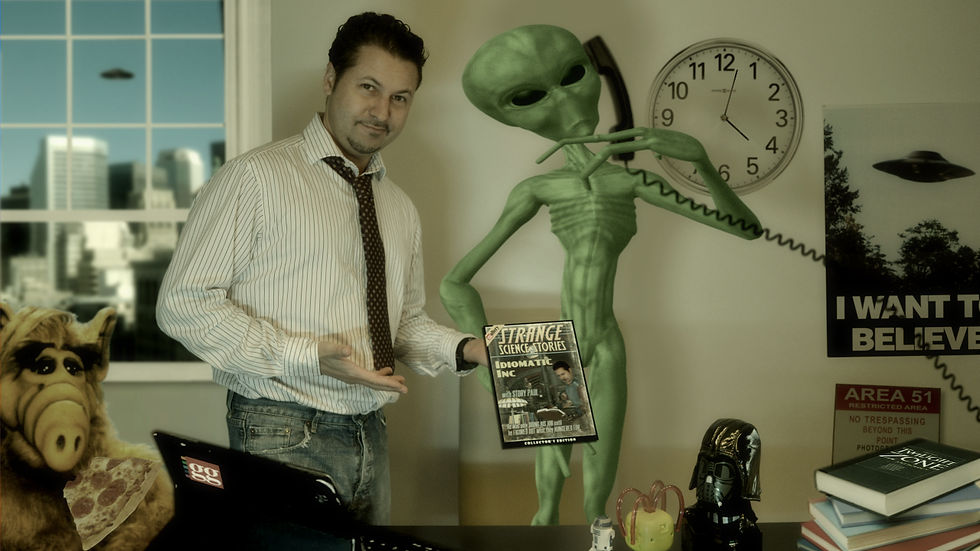
Idiomatic Inc. was a one-man sitcom for a London-based ESL company. I played Paul, an operator handling English emergencies: idioms, phrasal verbs, collocations. We never heard the callers. My end of the conversation was enough.
Between language questions, I fielded calls from my boss, my mechanic, my mother, and Area 51. A Sharpie tattoo on my arm became a back-talking sidekick. Then a robot wanted my job. And one special client was a T-Rex hoping to vacation in Manhattan.
You know. Standard ESL material.
Add canned laughter and Seinfeld-inspired slap bass, and my desktop Hollywood years had found another use.
Students and fellow teachers loved it. The school’s director? No comment.
Also, no second season.
Tough room.
Between those experiments and the corporate training, I kept developing my own way of teaching business English. StoryDeck grew into Storylingo: more tools for shaping the story, working on the language, and helping someone actually deliver it.
StoryDeck on steroids.
I’d gone back to teaching to earn a living. Somewhere in the process, the producer, the writer, and the teacher had started working together.
Good thing nobody told George Costanza.
Ya gotta pay the bills. Also, I’m pretty good at it.
The experiments had become a business. Somewhere along the line, I also became a TESOL-certified language jockey.
There. Papers to go with the nickname.
Marina might have been impressed. Too bad she and George didn’t live in the same universe. They would’ve really hit it off.
Anyway, at Story Paul, I helped people pass exams, survive job interviews, and get their ideas across without wrestling every sentence to the ground. Seeing someone get the job or finally nail a presentation was a pretty good payoff too.
The business grew. Through agencies and referrals, I worked with engineers, software specialists, and other professionals whose English had to do more than get them through an exercise.
They had projects to explain. Clients to convince. Careers on the line.
I taught workshops at Shell, Disney, and EY. Eventually, I was working with senior executives and C-level leaders.
The questions changed.
How do I explain this strategy? How do I get the board behind it? How do I tell my team something they’re probably not going to like?
Try solving that with the past perfect.
My work grew from teacher to coach to executive narrative advisor. That meant ghostwriting speeches and helping leaders work out their communication strategy: what to say, to whom, and how to make it land.
Storylingo grew with it. The system that started with one IT manager and his “Olympic judges” became a framework for helping people shape a message and deliver it.
Years of writing, directing, and editing turned out to be useful when someone had five minutes to make a room understand something complicated. So did learning to keep a crew of creatives focused when everyone had an opinion and the clock was ticking.
Who knew?
Teaching had carried me through dry stretches. Now the work had momentum of its own.

Along the way, the late Vicki Hollett and my friend Jason R. Levine, Fluency MC, invited me onto Simple English Videos for an episode about learning English through movies.
Two legends of the ESL world. Also two of the warmest, funniest people you could hope to work with.
Movies. English. That company. Count me in.
Jase also interviewed me about my Storylingo method for American TESOL. Getting to trade ideas with people I admired was a pretty damn good perk of the job.
The other worlds were still there
In 2020, Ozono came calling. Turns out they needed a reliable bilingual producer for an educational COVID-19 music video featuring Grammy-winning artists.
My friend Adrian, founder of Ozono, knew exactly who’d be up for that.
Back to production. Different circumstances. Had to fit it around Story Paul work, which was already in high gear.
Around that time, my old fantasy-pilot writing partner and I also took a run at a novel. We made progress, but couldn’t agree on where it should go. Eventually, we parked it.
Another story waiting in the garage.
I still wanted to bring together the things that had fascinated me for years: technologies nobody was supposed to know about, black-budget programs, unchecked power, secrecy, and plenty of action. I’d tried different ways in. None had quite clicked.
Then, in 2024, an English lesson handed me two words.
“Wait. What did you just say?”

Through an agency connecting me with students in Asia, I was teaching a young Korean student preparing for university. Engineering was in his plans. Hardworking kid. Demanding schedule.
He and his family asked me to keep his name out of this story. Fair enough.
One day, we were reading an article when he came across the name of notorious mob boss Al Capone.
“A.I. Capone.”
“Wait. What did you just say?”
He read it again.
“A.I. Capone.”
“No, no. That’s an L. Al Capone. You know who that is, don’t you?”
He didn’t.
Right. Historical detour.
The US in the 1920s. Prohibition. The government bans booze, and a gangster builds a business supplying it anyway. To give him a reference point, I brought up Korean crime movies he knew, including The Outlaws, starring Ma Dong-seok, aka Don Lee.
Talk about worlds colliding.
Dude was fascinated.
So was I. For slightly different reasons.
A.I. Capone.
Artificial intelligence with a gangster’s name. Somewhere in my head, a classified door had just swung open.
He eventually passed his exams and moved on. I told him his misreading had sparked a story idea. He was fine with that. Just leave his name out.
Cue imaginary glasses clinking across Zoom.
감사합니다. Gamsahamnida. Thank you, amigo.
Getting from those two words to A.I. Capone: The Digital Don, my debut novel published in 2025, took a hell of a lot more than correcting a letter. But I finally had a way to bring technology, corruption, secret programs, action, and my sense of humor into the same story.
This one made it out of the garage.
In September of that year, it reached number 1 on Amazon’s Sci-Fi Cyberpunk chart and went on to win the 2026 Indies Today Award for Best Science Fiction.
After the scripts, the pilot, the stalled projects, and all that waiting for the phone to ring, people were reading a world I’d created.
That did something to me.
The puzzle piece that doesn't fit
Look, you don’t need to write stories about digital mob bosses to qualify. Everybody’s got a quirk or two. A puzzle piece that doesn’t quite fit. Circles they can’t square. Worlds colliding.
You can spend your time trying to keep them apart. Or see what happens when you let them meet.
Turns out the producer, the teacher, and the writer had plenty to say to each other. Took me a while to listen.
These days, I deal in stories.
My clients’. My own.
Maybe your odd combination has something to offer too.
Or you can be George.


Comments